The island's story
Skopelos: myth and history
From the god of wine to the Venetians, the Ottoman centuries and the Greek state. A short walk through the island where you are getting married.
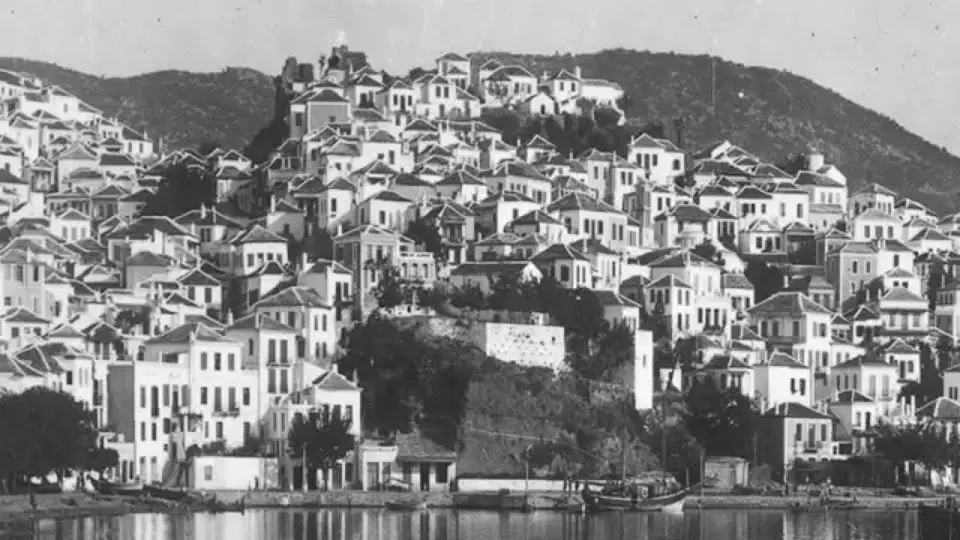
Myth
The island of the vine
In antiquity Skopelos was called Peparethos. According to legend it was settled by Staphylos, a name that means “bunch of grapes”, one of the sons of Dionysos, the god of wine, and Ariadne of Crete. Some tellings make Peparethos, who gave the island its old name, his brother.
There is something real behind the story. In the Bronze Age the island was settled from Crete, and the settlers are credited with bringing the vine. Peparethos was known for its wine across the ancient Greek world, and Sophocles’ Philoctetes is said to speak of “Peparethos, rich in grapes and wine”. A wreck of about 400 BC found off neighbouring Alonissos is reported to have been carrying wine jars loaded on Skopelos.
Beside Vrachos stands the chapel of the Holy Apostles, which is said to have been built over an ancient temple of Athena. We tell it the way it has been told to us, as a legend.
Antiquity to the Venetians
A fortress on the old acropolis
Colonists from Chalkis on Euboea settled the island after the Bronze Age, and Peparethos took part in the Delian League led by Athens.
The oldest surviving church in the town, the basilica of Agios Athanasios in the Kastro quarter, goes back to the 11th century, the same century as the chapel of the Holy Apostles beside Vrachos.
After the Fourth Crusade, in the early 13th century, the island passed to the Venetians. The Ghisi family built a fortress on the old acropolis, the Kastro that gives the quarter its name. The Byzantines recovered the island later in the 13th century, and after the fall of Constantinople in 1453 the northern Sporades turned to Venice again, according to local histories to keep clear of the Ottomans.
1538 to 1821
The Ottoman centuries
In 1538 the Ottoman admiral Hayreddin Barbarossa took the island after a raid that local histories remember as one of the hardest blows in its past. Skopelos then lived under Ottoman rule until 1830.
Accounts agree that the rule was loose. According to local histories the island ran much of its own affairs through its landowners and shipowners, who collected the taxes, and owed little beyond those taxes and a yearly levy of thirty sailors for the Ottoman fleet. They also say no Turkish population settled here.
These were also the years the island grew prosperous from the sea. Skopelos sailors and shipowners traded across the Mediterranean and the Black Sea, shipyards on the island built merchant ships, and local histories record consulates of Venice, England and France in the town in the 18th century.
1821 to 1830
The war and the Greek state
When the revolution began in 1821 Skopelos joined it with its fleet. Local accounts say the island’s shipyards gave about thirty-five merchant ships to the war.
The war cost the island much of its fleet, and pirates troubled the Sporades until Admiral Miaoulis cleared them in 1828. In 1830 Skopelos became part of the new Greek state. Histories add that its sailing fleet faded once steamships arrived.
The 20th century
A hard century, and the orchards
Like the rest of Greece, Skopelos was occupied in the Second World War, first by Italy and then by Germany.
In 1965 an earthquake struck, and after landslides the people of the village of Klima left it and built a new one, Neo Klima, also called Elios, on the coast.
Through all of it the island kept its orchards. Skopelos plums, dried as prunes in kilns heated with olive wood, are described in official tourism sources as a tradition that goes back to the 19th century.
Today
An island that still takes its time
Skopelos has no airport, and that is a large part of why it still feels the way it does. Guests land on Skiathos and finish the journey by sea.
The town alone has more than a hundred churches and chapels, and by most counts several hundred stand across the island. Many are opened only on the day of their saint.
In 2008 Mamma Mia! was filmed here, and brought the island to people who had never heard of it. If that is what brought you, our guide to the chapel of Agios Ioannis is a good place to start.
Dates differ between published histories. Where they disagree we have kept to what most of them agree on, and written “according to” where it matters.
Further reading: Municipality of Skopelos · Wikipedia